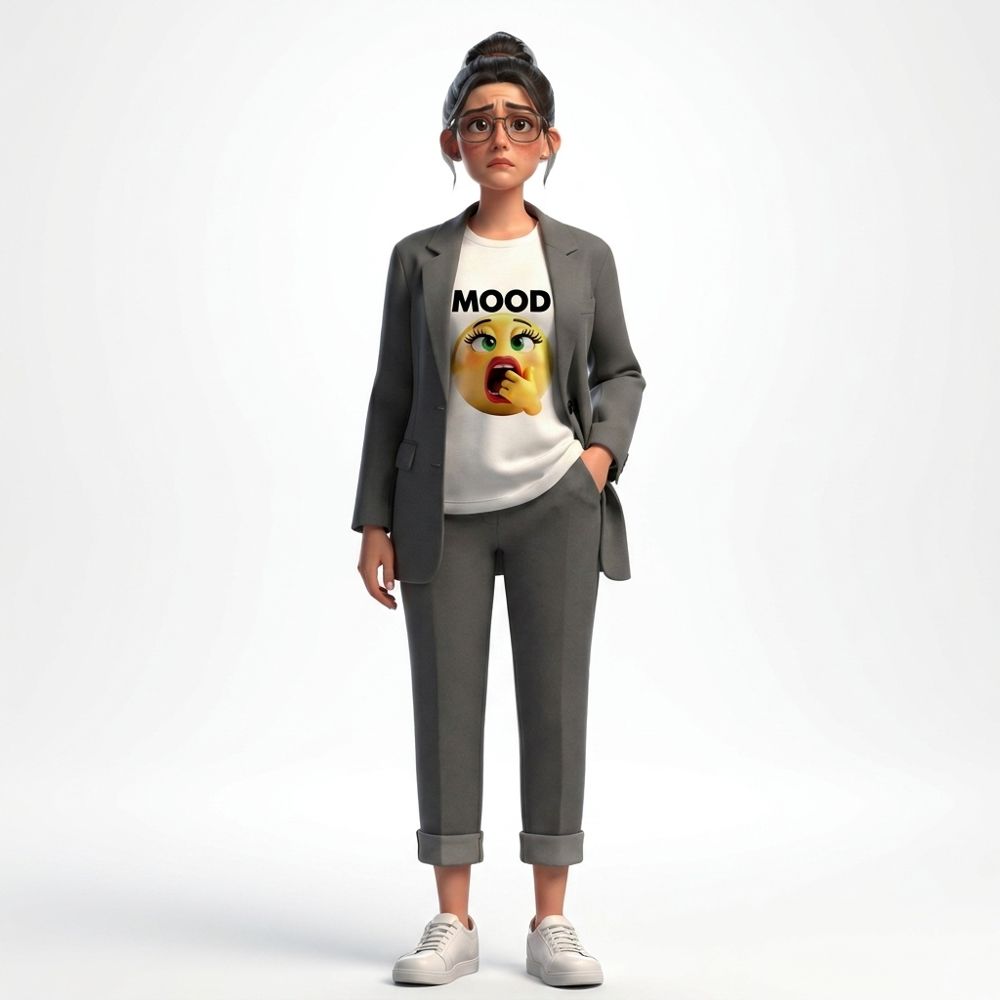
The invitation says costumes optional. Everyone knows what that means. Two people will go all in, three will refuse on principle, and the rest of the office will spend a week quietly wondering how much effort is the correct amount of effort.
There is a right answer, and it is lower effort than most people assume. Roughly 73% of consumers take part in Halloween in some form, so the season now reaches the workplace whether HR planned for it or not. What follows is what actually counts as work-appropriate, what gets people into trouble, and the minimum viable costume for each office scenario.
The short answer: a graphic tee with a seasonal joke is the safest work costume there is. It is legible, comfortable for eight hours, survives an unexpected client call, and cannot be misread by anyone in the building.
Do You Actually Have to Dress Up?
No, and any employer who makes it mandatory is creating a problem for themselves, since some employees decline for religious reasons and others simply do not want to. Sensible organisations say optional in writing and mean it.
That said, complete non-participation carries a small social cost in teams where most people join in. This is why the shirt option exists. It converts a decision that feels like a commitment into one that takes ten seconds in the morning.
What Counts as Work-Appropriate?
HR guidance on this is remarkably consistent across sources, and it comes down to whether the costume could plausibly make a colleague uncomfortable or a photograph awkward later. HR Dive frames the office Halloween party as a genuine liability surface, and HR specialists give consistent advice on where the lines sit.
Safe | Risky | Never |
|---|---|---|
Graphic tee with a seasonal joke | Full face paint | Another culture's traditional dress |
Themed jumper or accessory | Anything with a mask | Religious figures or clergy |
Cat ears, devil horns, novelty hat | Fake blood in client-facing roles | Anything sexualised |
All black plus one prop | Inflatable suits near desks | Current political figures |
Matching team shirts | Costumes that need explaining | A colleague as the punchline |
Two practical additions that written policies usually miss. Masks and heavy face paint break photo ID and security badge checks, which makes you the person holding up the door for a day. And weapons, including obviously fake ones, are a hard no in almost every corporate building.
The test that covers everything
If the costume were photographed and posted on the company's internal channel with your name under it, would you be relaxed about it? That single question filters out almost every costume that has ever caused an HR conversation.
What Should You Wear in Each Scenario?
The right answer changes with what your day actually looks like, not with how much you like Halloween.
Your day | Wear | Why |
|---|---|---|
Normal office day | Graphic tee, usual trousers | Reads as participation, needs no maintenance |
Client meeting that day | Tee under a blazer or shirt | Removable in the lift, present at the party |
All remote, video calls | Bold graphic, nothing subtle | The shirt is the entire costume on camera |
Warehouse, lab or kitchen | Tee only, no props | PPE and hygiene rules outrank Halloween |
Team photo or all-hands | Matching team shirts | Photographs well, no individual exposure |
What Do You Wear for a Halloween Video Call?
Remote teams have made this simpler than it has ever been, because only your top half exists. A hat leaves the frame, makeup detail vanishes into video compression, and a full costume is invisible below the collarbone. The shirt is the costume.
The one thing worth doing is testing it on camera once. Thin lettering and low contrast disappear at video bitrates, which is the same legibility problem Halloween lighting creates in person. Bold, high-contrast graphics survive both.
What Works for a Whole Team?
Matching shirts are the only group costume with no bad day attached. Nobody has to be the one inside the inflatable dinosaur, nobody has to reapply anything at lunchtime, and the photo goes into the internal newsletter without anyone wincing.
They work best when the joke belongs to the team rather than to Halloween in general, an in-house phrase, a recurring meeting, the thing the team says every single sprint. You can print exactly that line with the HollaBoo slogan generator, and the wording rules are in how to make a custom t-shirt with your own words. Seven words maximum, and no jokes at one person's expense.
If the shirts are being bought for other people rather than by them, the selection rules in funny gifts for coworkers apply, and they matter more than the Halloween part.
When Should You Order?
Two weeks ahead as a floor, more for a group. Print-on-demand apparel is manufactured after the order is placed, so production time comes before shipping time, and October is the busiest month of the year for every print house involved.
For team orders, collect sizes before you buy rather than after. The delay is never the printer, it is the two people who have not replied.
Practical deadline: individual orders by around October 17th, team orders by around October 10th.
The Verdict
The office costume problem is not really about costumes. It is about wanting to be a good sport without spending the day uncomfortable, visible for the wrong reasons, or stuck in something you cannot take off before a client call.
A shirt solves all three at once. It is why the safest answer in almost every workplace is also the easiest one. For the non-work version of the same question, including what to wear to an actual party, see funny Halloween shirts for adults.
Bottom line: optional means optional, but a graphic tee is ten seconds of effort that buys you out of the entire conversation.